- Views: 182
Professor Randy Schekman: “Academies of sciences can play a special role in fostering collaboration, both across disciplines and across national borders.”
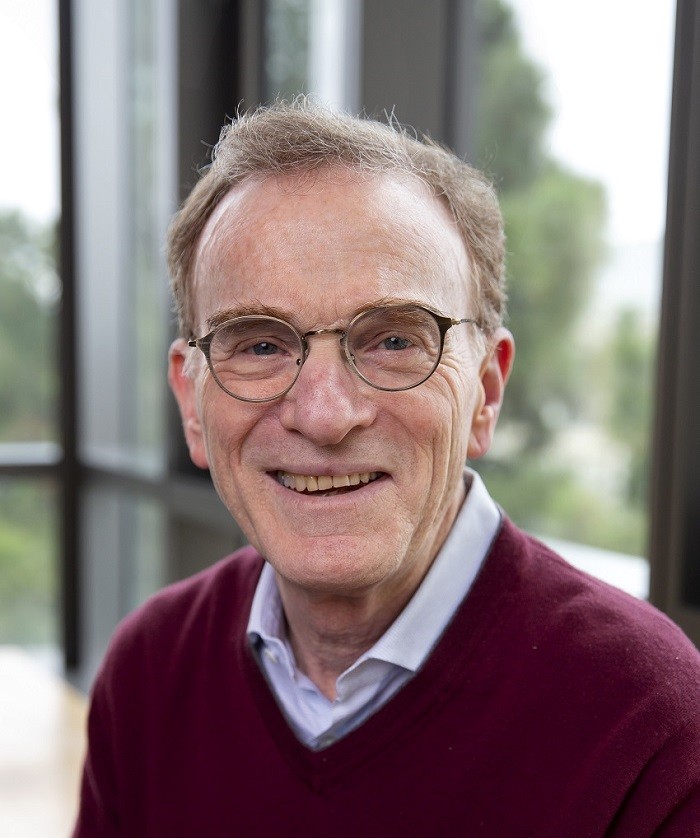
At a time when humanity is simultaneously facing unprecedented health, climate, and technological challenges, the role of science in the development of society is becoming increasingly important. How can academies contribute to strengthening public trust in research? How will artificial intelligence transform the medicine of the future, and why is international collaboration essential for the advancement of knowledge? These are some of the topics addressed in the dialogue with Professor Randy Schekman, recipient of the 2013 Nobel Prize in Physiology or Medicine, Honorary Member of the Academy of Sciences of Moldova (2021), and one of the leading figures in contemporary cell biology. His fundamental discoveries concerning the mechanisms of intracellular protein transport have transformed our understanding of essential life processes and opened new perspectives for the study of numerous human diseases.
Randy Wayne Schekman, Professor at the University of California, Berkeley, USA, and one of the world’s most highly regarded cell biologists, visited the Republic of Moldova for the second time. His first historic—and probably most eagerly anticipated—visit to the country where his family has its roots took place in 2023. As an interesting and certainly honourable detail, on the official Nobel Prize website, in his autobiographical essay, Professor Randy Schekman refers to his Bessarabian origins. The American professor has collaborated with the Academy of Sciences of Moldova since 2019, and given his genuine connection with the Republic of Moldova through his family history, the leadership of the Academy, represented by its President, Academician Ion Tighineanu, invited the renowned scientist to visit the Academy of Sciences of Moldova as early as 2020. The pandemic, however, prevented that visit from taking place, and the professor was finally able to fulfil his wish to visit the homeland of his ancestors three years later, in 2023. As the American cell biologist himself remarked, that visit marked the first return to the family’s roots by one of its members in nearly 100 years, and he regarded visiting the Republic of Moldova as a sacred duty.
In anticipation of his first visit to the Republic of Moldova and, respectively, to the Academy of Sciences of Moldova in 2020, I had the honour of conducting an exclusive interview with Nobel Laureate Randy Wayne Schekman
(https://asm.md/profesorul-randy-schekman-stiinta-poate-si-trebuie-utilizata-pentru-ghida-politica-publica).
The interview recorded more than 1,000 views in just one day. Equally memorable was the lecture delivered by the scientist at the Academy of Sciences of Moldova in 2023, in which he highlighted the role of science and the benefits of research for health, industry, and economic development, as well as for people themselves: “Science can and should be used to guide public policy on urgent issues such as global health, food supply, energy, education, and climate.”
Returning to the country of his ancestors on the occasion of the 65th anniversary of the founding of the Academy of Sciences of Moldova, in June 2026, the American scientist had a diverse programme of activities. His return further confirms the continuity of the collaborative relationship with the Academy of Sciences of Moldova and the shared interest in strengthening international scientific dialogue.
In the second interview, which I conducted following the events organized by the Academy of Sciences of Moldova in the anniversary context, we discussed the role of academies in the modern world, frontier research, the importance of communication between scientists and the public, the impact of emerging technologies on research, the ethical implications of artificial intelligence, as well as the need for international cooperation in the context of the International Decade of Sciences for Sustainable Development (2024–2033), proclaimed by the United Nations.
We therefore invite you to follow this exclusive dialogue with the distinguished professor from across the Atlantic, who shares reflections on the future of biology and medicine, the vocation for science, and both the role and responsibility of scientists in contemporary society. We hope that this dialogue will be of interest to researchers, doctoral students, university students, and the wider public interested in science.
Interview by:
Eugenia TOFAN
Professor Randy Schekman, in a world marked by rapid transformations and an increasing number of global challenges, what do you see as the role of academies of sciences?
Randy Schekman: One essential role of academies of sciences is to recognize the achievements of a country’s most distinguished scientists, bring them together, and provide a framework in which they can advance shared scientific interests. One of the most important objectives, however, is dialogue with society. The public supports research through its contributions and through the policies adopted by decision-makers, and people need to understand the value that science brings to society.
And what about the role of scientists themselves? Are we doing enough to communicate research findings to the public?
Randy Schekman: One important responsibility of scientists is to explain to society what we do in our laboratories, what benefits research brings to health, industry, and economic development, and what further investment in scientific activity can make possible. Many of the achievements of recent years are still not sufficiently known to the wider public. I know the fields of medicine and biomedical sciences very well, and I can say in simple terms that advances in the treatment of cancer, cardiovascular disease, and, more recently, genetic disorders have profoundly changed medicine, have revolutionized human health, and will continue to do so. These discoveries not only extend life expectancy but also give people the opportunity to live longer and healthier lives.
We already have highly effective medicines for treating cardiovascular disease by lowering cholesterol. At the same time, innovative therapies are being developed that may involve a single injection capable of modifying a gene in our genome so that the body permanently produces lower levels of harmful cholesterol.
Since you have raised this important subject, can we now also speak about treatments for genetic diseases that were once considered impossible to treat?
Randy Schekman: Yes. There are also new treatments for genetic diseases. Whereas in the past these disorders were virtually impossible to cure, it is now becoming possible to correct certain genetic mutations and restore the normal function of the affected gene. These advances are closely related, for example, to technologies that made possible the development of messenger RNA vaccines, which saved millions of lives during the COVID-19 pandemic. The same technological platforms are already finding applications in the development of new cancer therapies and in correcting harmful genetic mutations.
These are achievements made by scientists around the world, and they will benefit people in the Republic of Moldova, Romania, Eastern Europe, and beyond. That is precisely why it is important for the public to be aware of these developments, because discoveries of this kind require investment from society through taxation and through decisions made by legislators, giving scientists the opportunity to do what they do best — make discoveries. Scientists transform these investments into knowledge and innovation, which are subsequently harnessed by industry, medicine, and efforts to improve human health.
Professor, artificial intelligence is entering almost every sphere of life at an increasingly rapid pace, while its ethical implications are becoming ever more apparent. Do you believe that clear limits should be established for the use of this technology, and how can we ensure that certain ethical boundaries are not crossed?
Randy Schekman: Artificial intelligence represents a major leap in our capacity to process and analyse information. Like any revolutionary technology, however, it must be understood in depth, and society must be aware of both its advantages and its limitations.
To the extent that artificial intelligence can affect people’s lives, it is natural that regulatory mechanisms should exist, just as they have for other technologies that changed the course of history. Nuclear technology is a relevant example. It was initially developed as a destructive force of unprecedented power. Later, through international treaties and efforts to control nuclear proliferation, the international community sought to limit the risks associated with it. At the same time, nuclear energy became an important source of electricity, and in the future nuclear fusion may offer an almost inexhaustible source of energy, helping to reduce dependence on fossil fuels.
Any technology with such profound impact brings both benefits and risks. That is why it is essential for society to be aware of these challenges and for those responsible for public policy to understand the technology well enough to establish clear rules for its use. At the same time, artificial intelligence is already an extremely valuable tool for scientific research, including in the life sciences. It is currently being applied in the discovery of new medicines. With the help of artificial intelligence, it is possible to design molecules that would be difficult to develop using traditional chemical methods. These molecules may provide the basis for innovative drugs to treat serious diseases.
Artificial intelligence is therefore an emerging technology with extraordinary potential, which scientists will, for the most part, use for the benefit of humanity. Nevertheless, technologies of this kind require responsible oversight and an appropriate regulatory framework. This responsibility does not belong exclusively to scientists, but also to decision-makers and to those responsible for legislation and the funding of science.
Professor, the United Nations has proclaimed 2024–2033 the International Decade of Sciences for Sustainable Development, emphasizing the need for multidisciplinary approaches to addressing society’s major challenges. In the Republic of Moldova, universities generally have specific profiles — engineering, medicine, agriculture, the humanities, and so forth — whereas the Academy of Sciences covers virtually all fields. Do you think it would be reasonable for the Academy of Sciences of Moldova to promote and coordinate multidisciplinary projects of national interest, perhaps with dedicated support from the state? Could this be an effective model for addressing the challenges of sustainable development?
Randy Schekman: Academies of sciences can play a special role in fostering collaboration, both across disciplines and across national borders. The purpose of fundamental research is to understand nature and make discoveries that help us explain the world in which we live. There should be no political interference in the pursuit of such discoveries. Academies should persuade not only people in their own countries but also decision-makers at the regional and international levels to allow, encourage, and promote the cross-border movement of scientists throughout the world. There should be no artificial barriers to the mobility of scientists pursuing fundamental research.
At the same time, the tradition of fundamental science has often favoured the individual investigator. The system of recognition in science typically rewards a scientist — an individual who leads his or her own laboratory and research team. Yet when it comes to the major problems affecting humanity, small and isolated discoveries are not always sufficient to produce truly transformative advances.
That is why it is essential to develop mechanisms that stimulate broad collaboration, not only within a single institution but also between institutions and across countries. New funding mechanisms that support not only interdisciplinary research but also collaborative research across national borders would represent an important way forward in addressing the most difficult problems.
Could you give us a concrete example of such an international collaborative effort?
Randy Schekman: Certainly. From my own experience, I can say that I have benefited from the support of a private foundation in developing an international collaborative research network devoted to understanding the fundamental mechanisms of Parkinson’s disease. A philanthropist with remarkable vision invested one billion dollars in establishing interdisciplinary and international teams working together toward a common objective: understanding the molecular and cellular basis of this disease. Such a collaborative model makes possible discoveries that would be much more difficult for laboratories working independently to achieve. This is a compelling example of an international collaborative effort that can be used to address some of the greatest scientific and societal challenges.
Professor Randy Schekman, at the conclusion of this dialogue, I would like to thank you for the time you have devoted to this interview and for the openness with which you have shared your experiences, reflections, and perspectives from your work. Discussions of this kind offer more than information — they provide context, meaning, and points of reference for understanding the processes behind decisions and outcomes. We wish you continued success in your work and in the projects you lead.
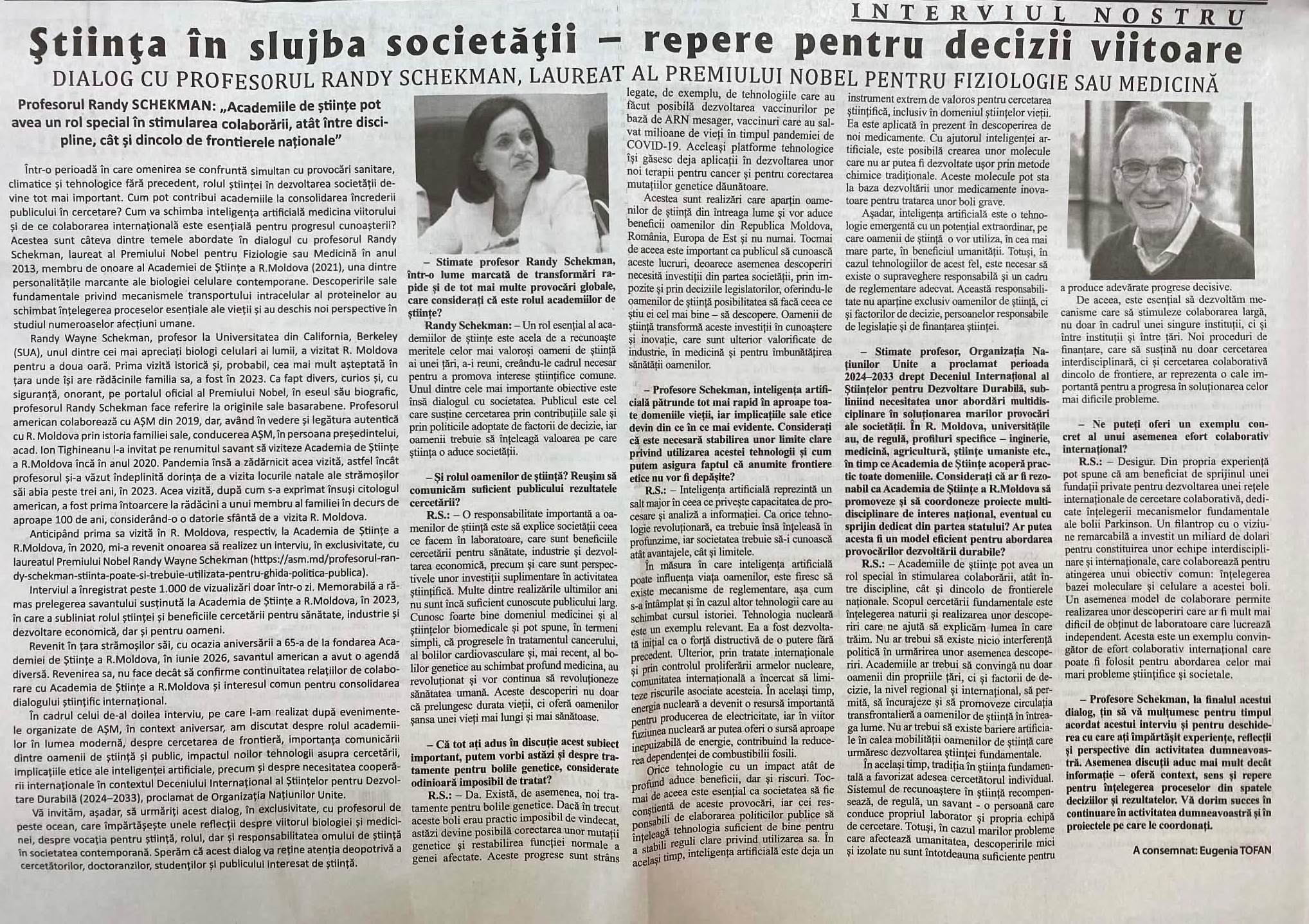
The interview with Nobel Laureate Professor Randy Schekman was published in the magazine Literatura și Arta, No. 30 (4219), dated 23 July 2026, on page 2.