- Views: 39
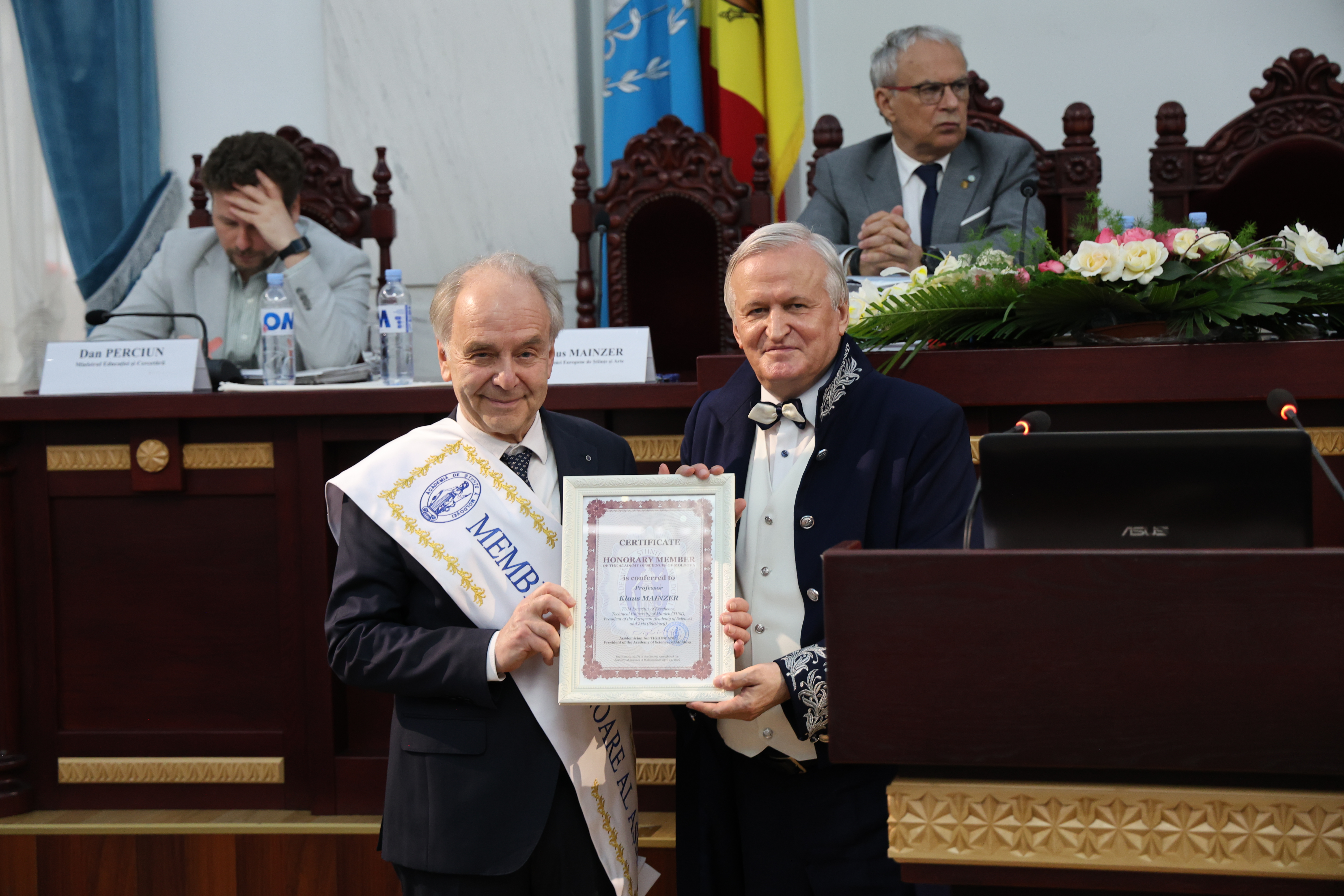
The 2026 Nobel Prize in Chemistry, awarded to Henri B. Kagan (France) and Kenso Soai (Japan) “for the discovery of non-linear effects and autocatalysis in asymmetric organic synthesis,” brings renewed attention to one of nature’s most fascinating mysteries: why does life favor certain molecular forms when their mirror images appear equally possible? This fundamental question has intrigued Professor Klaus Mainzer since the 1980s. President of the European Academy of Sciences and Arts and an Honorary Member of the Academy of Sciences of Moldova, Professor Mainzer is an internationally renowned scholar whose name is now particularly associated with his contributions to artificial intelligence.
When viewed in a mirror, the left and right hands appear identical, yet they cannot be perfectly superimposed. A similar phenomenon occurs in the molecular world. In chemistry, this property is known as chirality, and molecules that are non-superimposable mirror images of each other are called enantiomers. Remarkably, the proteins of living organisms are composed almost exclusively of amino acids with the L-configuration, although their mirror-image D-forms also exist. Why has nature developed this preference? How did the molecular asymmetry of life emerge in a universe governed by fundamental laws characterized by numerous symmetries?
These questions have fascinated generations of scientists, including Professor Klaus Mainzer, who is best known today for his research on artificial intelligence, complex systems, and the philosophical implications of emerging technologies. Less widely known is the fact that, from the early stages of his scientific career, the German scholar developed a profound interest in the fundamental problems of symmetry, geometry, and the organization of nature.
Following his habilitation thesis, entitled “Space, Geometry and Continuum,” Klaus Mainzer pursued in-depth studies of mathematical and physical symmetries. During his early years as a professor at the University of Konstanz, he collaborated with researchers at the prestigious ETH Zurich. In the early 1980s, during a lecture delivered at ETH Zurich, he explored the symmetry of nature, drawing inspiration from a striking literary image in Thomas Mann’s novel The Magic Mountain: the fascination of the protagonist, Hans Castorp, with the geometric perfection of snow crystals. Reflecting on the remarkable symmetries of the physical world, Mainzer raised a fundamental question: if nature allows two mirror-image molecular forms to exist, why do living organisms favor one over the other?
In 1988, Klaus Mainzer published his extensive monograph Symmetrien der Natur (Symmetries of Nature) with De Gruyter, examining the role of symmetry and symmetry breaking in mathematics, physics, chemistry, and biology. In the same year, he published the article “Symmetries in Nature. Perspectives in the Philosophy of Chemistry” in the scientific journal CHIMIA, further exploring the connections between the fundamental laws of nature and chemical phenomena.
One of the hypotheses he examined concerned the possible influence of the weak nuclear interaction, which violates mirror symmetry, on the preference for a particular molecular configuration. This fundamental property of physics can give rise to extremely small energy differences between chiral molecules. However, whether such differences actually contributed to the emergence of biological homochirality remains an open scientific question.
The 2026 Nobel Prize in Chemistry brings this issue back into focus from a complementary perspective. Prof. Henri B. Kagan made fundamental contributions to understanding nonlinear effects in asymmetric catalysis, demonstrating that the relationship between the chiral composition of a catalyst and that of the reaction product can be far more complex than simple proportionality. Prof. Kenso Soai, in turn, demonstrated a remarkable phenomenon of asymmetric autocatalysis, in which the product of a reaction promotes its own formation, amplifying the preference for one of the two mirror-image molecular forms.
To appreciate the significance of these discoveries, imagine two mirror-image molecular forms initially present in almost equal amounts. If one has even the slightest advantage, certain autocatalytic reactions can amplify this difference until one form becomes predominant. Thus, an initially almost imperceptible asymmetry can be transformed, through chemical reactions, into a pronounced molecular preference.
These discoveries have important implications for chemical synthesis, the pharmaceutical industry, and our understanding of the mechanisms underlying the emergence of homochirality. Nevertheless, they do not definitively establish the origin of the initial chiral preference during the emergence of life.
While Klaus Mainzer investigated the possibility that the origin of this preference might be linked to fundamental physical laws, the Nobel laureates elucidated chemical mechanisms through which differences between chiral forms can be amplified. Although distinct, these two research directions illustrate the complementary roles of physics, mathematics, and chemistry in exploring some of nature’s deepest mysteries.
Professor Mainzer’s interest in symmetry is by no means confined to the past. In 2024, he published the paper “The Emergence of Symmetries in Classical Physics” in the Journal of Physics: Conference Series, revisiting the role of symmetry as a fundamental guiding principle of scientific knowledge. The paper traces the evolution of concepts of symmetry from ancient philosophy and classical geometry to modern physics, highlighting the connections between mathematical structures and the laws of nature.
Although his name has become increasingly associated with artificial intelligence in recent decades, Professor Klaus Mainzer’s scientific contributions encompass a much broader spectrum of fundamental questions. He exemplifies a truly versatile and interdisciplinary scholar, capable of identifying profound connections between seemingly distant fields and approaching the great challenges of scientific inquiry from an integrative perspective.
The Academy of Sciences of Moldova highly appreciates the scientific achievements of Professor Klaus Mainzer, President of the European Academy of Sciences and Arts and an Honorary Member of the Academy of Sciences of Moldova, whose research interests reflect the enduring importance of fundamental science and interdisciplinary collaboration.
This fascinating history illustrates that major scientific discoveries do not emerge in isolation. They are the outcome of intellectual efforts spanning decades, dialogue across disciplines, and the courage to ask fundamental questions, even when the answers may seem far beyond reach.
Why does life favor one molecular mirror image over the other? A complete answer remains one of science’s outstanding challenges. Yet the research of Professor Klaus Mainzer and the discoveries of the 2026 Nobel laureates in Chemistry demonstrate how fruitful the interplay between physics, mathematics, chemistry, and biology can be.
At a time when society increasingly focuses on the immediate outcomes of emerging technologies, this story conveys a fundamental message: science advances not only by finding answers, but also by asking profound questions capable of inspiring generations of researchers.
Acad. Ion Tighineanu, president of the Academy of Sciences of Moldova